
Business account in Finland 2026: why banks say no and where you can still open one
Published · Author: Palvemax OY
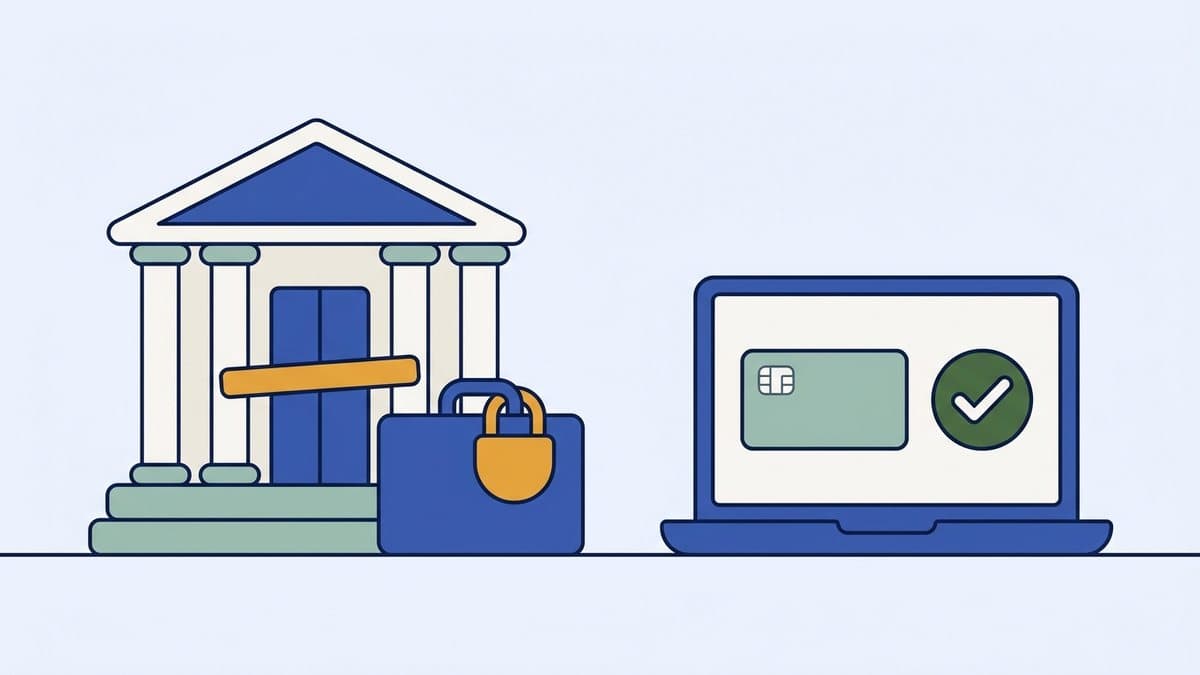
A bank in Finland has no duty to open an account for a company. Consumers have a statutory right to a basic payment account, but companies do not. The government has proposed giving micro and small companies the same right from 1 July 2027. Until then, whether you get an account is up to the bank.
We went through this ourselves. When we applied for an account for our company, Palvemax Oy, Nordea, OP, Danske Bank and S-Pankki all said no. Alisa Pankki finally opened one. Below is what we wish we had known beforehand: why a bank is allowed to say no, what it asks for and where you can still get a business account, for example from the payment institution Holvi.
- 4
- major banks turned us down
- about 11%
- of account applications from legal entities rejected in 2024
- 0.8%
- of applications from private individuals rejected in 2024
- 1 July 2027
- basic account for small firms, if Parliament passes the law
Our story: four banks, four refusals
We applied to four major banks. The answer was the same every time: no. Nobody gave us a clear reason, so we were left guessing. We believe two things decided it: the new company had no banking history, and we are from Ukraine.
In the end Alisa Pankki, a far smaller bank than the first four, opened the account. When we looked into it, we found that our case was not unusual. According to Suomen Yrittäjät (the Federation of Finnish Enterprises), banking services have been refused above all to entrepreneurs with an immigrant background. In recent years the problem has spread to many more micro and small businesses.
Why a bank can say no
The Finnish Anti-Money Laundering Act (rahanpesulaki) requires a bank to know its customers. Before opening an account, the bank must obtain sufficient information about the company’s business, its owners and its beneficial owners. It must also monitor where the money comes from. In practice, the bank has to understand who is behind the company and where its money comes from. If it cannot, or does not like what it sees, there is no account.
Banks also cut risk, a practice known as de-risking: they restrict services or turn away customers whose risk they do not want to carry. According to a thematic review published by the Finnish Financial Supervisory Authority (FIN-FSA) in 2025, banks rejected about 11% of account applications from legal entities in 2024, against 0.8% of applications from private individuals. In other words, a legal entity was turned down almost 14 times as often as a private person. Over 60% of terminated legal-entity relationships in 2022–2024 were driven by anti-money laundering obligations.
Nor does a company have a right to an account. The Suomi.fi public service portal says it plainly: banks have no obligation to open an account for a company. The duty to provide basic banking services currently applies only to private individuals.
What the bank asks for when you open an account
Requirements vary by bank and by company form. According to Suomi.fi, the bank usually asks for at least the following.
| Document or information | Sole trader (toiminimi) | Limited company (Oy) |
|---|---|---|
| Trade register extract or registration certificate, no older than 3 months | yes | yes |
| Description of the business, such as a business plan | yes | yes |
| Estimate of payment traffic: number and size of payments | yes | yes |
| Identity document | yes | yes |
| Articles of association (yhtiöjärjestys) | – | yes |
| Board minutes on opening the account and who may use it | – | yes |
| Up-to-date shareholder register (osakasluettelo) | – | yes |
Be ready to explain clearly what the company does, who your customers are and how many payments go through the account each month. Follow-up questions are common, so answer them quickly.
The law is changing: a basic account for companies from 1 July 2027
In autumn 2026 the government submitted a bill to Parliament (HE 208/2026 vp) that would extend the right to basic banking services to micro and small companies, self-employed traders (elinkeinonharjoittajat), associations and foundations. The law would create a new basic payment account for companies and organisations.
Deposit banks that offer similar services to legal entities or self-employed traders would also have to offer this account to micro and small companies. The law would set clear grounds on which the account can be refused or terminated. The FIN-FSA would get wider rights to obtain information from banks.
The laws are intended to enter into force on 1 July 2027. The bill is still before Parliament, so its content and timetable may change. Until then, the law is no help.
An alternative to a bank: a payment institution’s business account
You can also open a business account with a payment institution (maksulaitos). It is not a bank, but its business account comes with an IBAN and a payment card, so invoicing and payments work much as they do at a bank. Holvi, a Finnish payment institution, operates under a payment institution licence granted by the FIN-FSA.
A Holvi business account is opened online. You identify yourself with Finnish online banking credentials or a mobile certificate (mobiilivarmenne), enter the company’s details and choose a plan. A trade register extract is usually the only document needed. A sole trader not entered in the trade register can send a screenshot of their YTJ details.
On the Flex plan with no monthly fee, you pay only for transfers. The paid plans include more accounts and cards, the Pro and Business plans add e-invoicing, and the Zen plans include an accountant.
Check Holvi’s conditions before you apply:
- The company must already be registered.
- You need Finnish online banking credentials or a mobile certificate to identify yourself.
- A sole trader must live in Finland.
- A limited company cannot pay its share capital into a Holvi account.
- Holvi also checks its customers and can refuse to open an account.
Bank or payment institution: the differences
| Bank | Payment institution (Holvi) | |
|---|---|---|
| Obliged to open an account for a company | not today; proposed for micro and small companies from 1 July 2027 | no |
| Opening the account | online or at a branch | online |
| Identification | banking credentials or an ID document at a branch | Finnish banking credentials or a mobile certificate |
| Finnish IBAN | yes | yes |
| Share capital payment and proof for PRH | yes | no |
| Deposit guarantee | up to €100,000 per depositor per bank | Holvi takes no deposits; customer funds are kept separate from Holvi’s own funds |
If the bank says no: what to do
- Ask the bank which information the decision hinged on. If it was a missing document or an unclear explanation, complete your application.
- Apply to another bank. Banks assess risk differently: Alisa Pankki opened our account after four major banks had refused.
- Open a business account with a payment institution such as Holvi, if your company is registered and you have Finnish identification credentials.
- Setting up a limited company? The share capital of a private limited company can be €0. Then you need no account before registration: you can open one once the company is in the trade register.
- If you are a sole trader, do not run business payments through your personal account for long. Since October 2025, online banks check whether the payee’s name matches the account holder’s name. If your invoice shows your business name but the account is in your own name, the payer sees a warning. Some banks’ terms also forbid using a personal account for business.
- Watch the law: if Parliament passes the bill, micro and small companies will have a right to a basic payment account from 1 July 2027.
Calculators for this topic
FAQ
Can a bank refuse to open a business account?
Yes. Banks have no obligation to open an account for a company, because the duty to provide basic banking services currently covers only private individuals. Under the government bill, micro and small companies would get a right to a basic payment account from 1 July 2027, if Parliament passes the law.
Why do banks refuse business accounts?
Under the Anti-Money Laundering Act, the bank must know its customers. If it cannot get enough information about the company, its owners and the source of funds, or judges the risk too high, it does not open the account. According to Suomen Yrittäjät, refusals have hit entrepreneurs with an immigrant background in particular. A co-owner’s payment default or international trade can also be the reason.
Does a sole trader need a separate business account?
The law does not require one, but a separate account is worth having because it keeps the bookkeeping clear. Some banks’ terms also forbid using a personal account for business. In addition, payee verification warns the payer if the invoice shows your business name but the account is in your own name.
Can I set up a limited company without a bank account?
Yes, if the share capital is €0. You then open the account once the company is registered. If the shares have a subscription price, it must be paid into the company’s bank account before registration. The registration notice needs an auditor’s certificate or, if there is no auditor, a bank statement or other proof of payment from the bank.
Is Holvi a bank?
No. Holvi is a payment institution licensed by the Finnish Financial Supervisory Authority. It takes no deposits but keeps customer funds separate from its own. A Holvi business account has a Finnish IBAN and a payment card.
What do I need to open a Holvi business account?
The company must be registered, and you need Finnish online banking credentials or a mobile certificate for identification. A sole trader must live in Finland. A trade register extract is usually the only document needed.
When will the basic account for companies take effect?
Under government bill HE 208/2026 vp, the laws are intended to enter into force on 1 July 2027. The bill is before Parliament, so its content and timetable may still change.