
Mortgage and the loan cap in Finland 2026: how much can you borrow?
Published · Author: Palvemax OY
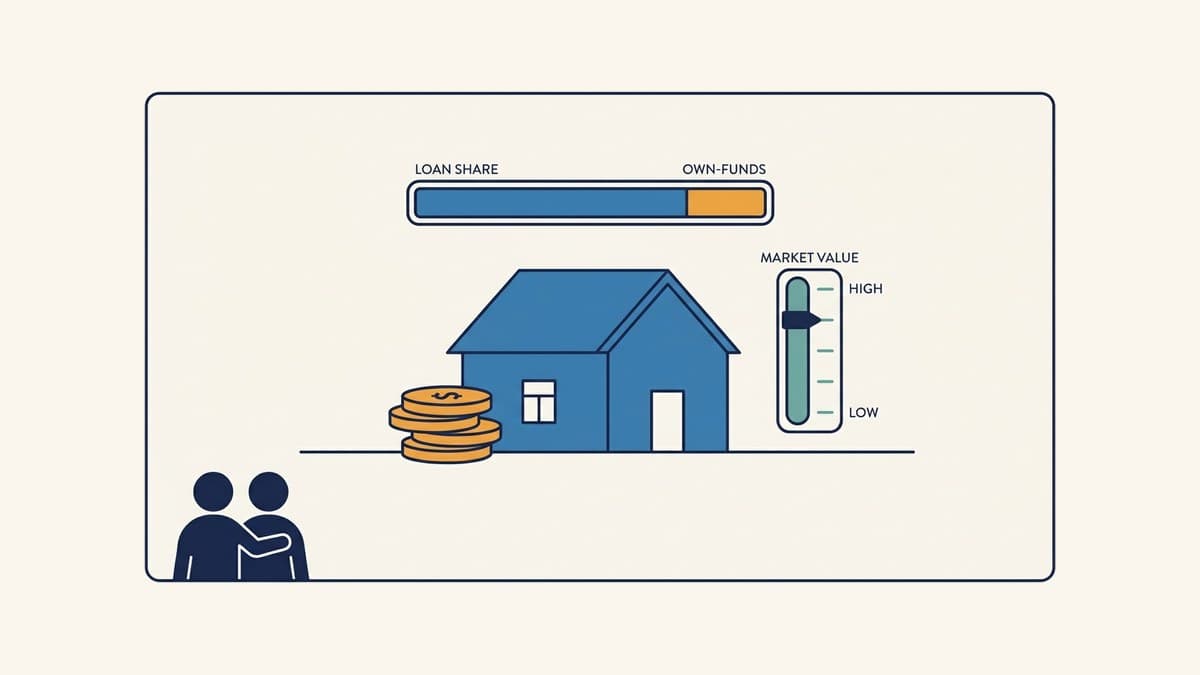
The Financial Supervisory Authority raised the loan cap to 95 percent for all borrowers by its decision of 30 June 2026. A mortgage may therefore be at most 95 percent of the value of the collateral, which means you need at least 5 percent of your own funds.
The second constraint is the expense cap: servicing all your loans may take at most 60 percent of your net income. Below are both limits, the stress test and worked examples.
- 95 %
- loan cap on collateral value
- 5 %
- minimum own funds
- 60 %
- expense cap of net income
- 6 %
- stress test rate
Two limits: the loan cap and the expense cap
In practice two things limit the size of a mortgage. The first is the loan cap, the maximum loan-to-collateral ratio: the loan may be at most 95 percent of the value of the collateral. The second is servicing capacity: the bank must test that the applicant can service all their loans if rates rise. Both are Financial Supervisory Authority limits and recommendations rather than a guarantee of approval – the bank always makes an overall assessment of credit history, employment, living costs and collateral.
The 95 percent loan cap
The loan cap means the loan may be at most 95 percent of the value of the collateral. In practice the buyer must cover at least 5 percent of the price with their own money or additional collateral. For a 250,000-euro home, for example, you need at least 12,500 euros of your own funds. The collateral can be the home being bought plus other property or a guarantee, in which case the loan can cover a larger share of the home price itself.
The 60 percent expense cap on net income
The expense cap means the servicing costs of all loans together may be at most 60 percent of the applicant’s net income. The limit has applied since 1 January 2026. The calculation includes not only the mortgage but other credit as well: consumer loans, a car loan, a student loan and credit card debt. If net income is 3,000 euros a month, servicing all loans may take at most 1,800 euros.
The stress test: 6 percent over 25 years
Servicing capacity is not tested at the current rate but at a stressed one. The bank must verify that the applicant could still service their loans if the rate rose to 6 percent and the loan were repaid over 25 years. This is often the real bottleneck: a longer loan term does not help, because the test is always run over 25 years. In practice the stress test limits the amount more often than the loan cap does.
- The loan cap limits the loan as a share of collateral value (at most 95 %).
- The expense cap limits servicing costs as a share of net income (at most 60 %).
- The stress test sizes the loan at a 6 % rate over 25 years.
- A bank may apply its own, stricter internal limits.
Calculators for this topic
FAQ
How much of your own money do you need for a mortgage in 2026?
At least 5 percent, because the loan cap is 95 percent of collateral value from 30 June 2026. For a 250,000-euro home, for example, you need at least 12,500 euros of your own funds.
What is the expense cap?
The expense cap means servicing all loans may take at most 60 percent of net income. The limit has applied since 1 January 2026 and includes consumer loans, a car loan and a student loan as well.
How does the bank stress test work?
The bank must test that the applicant can service all their loans if the rate rose to 6 percent and the loan were repaid over 25 years. The test is always run over 25 years, so a longer loan term does not increase the amount in the test.
Are student and consumer loans counted?
Yes. The expense cap calculation includes the servicing costs of all credit: the mortgage, consumer loans, a car loan, a student loan and credit card debt.
Is there a different loan cap for first-home buyers?
Not any more. The Financial Supervisory Authority raised the loan cap to 95 percent for all borrowers on 30 June 2026, so the same limit applies to first-home buyers and everyone else.
Does the calculation guarantee you will get the loan?
No. The loan cap and the expense cap are Financial Supervisory Authority limits and recommendations. The bank makes an overall assessment of credit history, employment and collateral and may apply stricter internal limits.