
Public broadcasting tax 2026: €13.33 a month for almost everyone
Published · Author: Palvemax OY
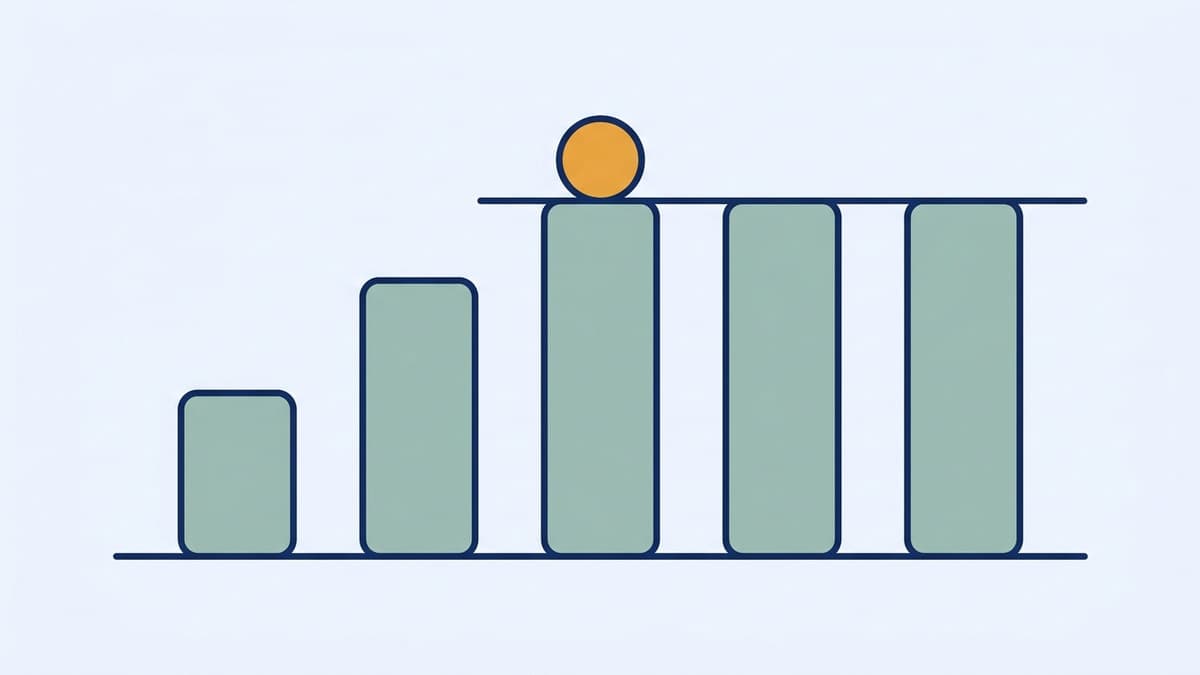
The Finnish public broadcasting tax is the flattest item in the whole tax system. It is 2.5 per cent of income exceeding €15,150 a year, capped at €160. The cap is reached at an annual income of €21,550 – roughly €1,800 a month.
After that it stops growing. Someone earning thirty thousand and someone earning three hundred thousand pay exactly the same €160 a year, €13.33 a month. In practice every full-time employee pays the same amount, and below €15,150 nobody pays anything at all.
- 2.5 %
- of income above the floor
- €15,150
- floor – nothing is paid below it
- €160
- annual maximum
- €21,550
- income at which the cap is reached
A tax that lives in a €6,400-wide band
The entire progression of the broadcasting tax fits between €15,150 and €21,550. Across that six-thousand-four-hundred-euro band the tax rises from zero to €160. Above the band it is constant; below it, zero.
| Annual income | Tax per year | Per month |
|---|---|---|
| €15,150 or less | €0.00 | €0.00 |
| €16,000 | €21.25 | €1.77 |
| €18,000 | €71.25 | €5.94 |
| €20,000 | €121.25 | €10.10 |
| €21,550 or more | €160.00 (cap) | €13.33 |
This produces something rare in Finnish taxation: the broadcasting tax is regressive. At €20,000 of income it is 0.61 per cent, at €50,000 it is 0.32 per cent and at €100,000 it is 0.16 per cent. The higher the income, the smaller the share.
The base is all income, not just salary
The base is the combined total of net earned income and capital income. That means salary, pension, self-employment income, rental income, dividends and capital gains all count. It mainly surprises people whose earned income is small but whose capital income is large: someone living on dividends alone pays the broadcasting tax just as an employee does.
The tax is collected as part of ordinary taxation. For an employee it sits inside the withholding rate on the tax card, so it never appears as its own line on a payslip. For a pensioner or an entrepreneur it arrives through withholding or advance tax in the same way.
Who stays below the floor
The annual floor of fifteen thousand one hundred and fifty euros works out to €1,262 a month. Full-time pay clears it essentially always, so the people below it are mainly part-timers, students, those unemployed for part of the year, and pensioners on the smallest pensions.
What decides it is which income counts. The base is net earned and capital income, and it includes many benefits – but not all of them.
- Counted: salary, pension, self-employment income, the study grant, unemployment allowance and labour market subsidy, sickness and parental allowances, plus rental income, dividends and capital gains.
- Not counted: general housing allowance, social assistance, child benefit, maintenance allowance and the housing supplement to student aid – these are tax-free and do not raise the base.
- For a student that means the study grant builds the base while the housing allowance does not, so student benefits alone usually leave the floor unreached.
- A student with a summer job can still cross it, if pay and the study grant together exceed €15,150 over the year.
Deductions do not reduce it
This is the tax’s second unusual feature. Ordinary income tax is reduced by the earned-income credit, the basic deduction and other reliefs, but none of them touch the broadcasting tax. It is calculated on net earned and capital income before deductions and charged in full.
In practice that means commuting costs, union fees and the household tax credit will not reduce your broadcasting tax by a single euro. The only way to pay less is to earn under €21,550 a year – which is nobody’s goal.
The corporate broadcasting tax is a separate thing
Corporations pay a broadcasting tax of their own, unconnected to the personal one and with no effect on it. It applies to limited companies, cooperatives and other entities whose taxable income exceeds a threshold, and it is calculated with a different formula. A sole trader pays the personal tax, because a sole trader is not a separate taxpayer.
For an entrepreneur the point is that income is not counted twice. If you operate as a sole trader, the business result is part of your personal income, and the broadcasting tax is determined once from that whole. The owner of a limited company, by contrast, can pay from two directions: the company pays its own tax and the owner pays the personal one on the salary and dividends drawn. The two are independent, and neither reduces the other.
What the €160 buys
- The broadcasting tax is earmarked: it is channelled through the state budget to fund Yleisradio.
- It does not depend on using the services, so it is paid by people who never watch or listen to Yle.
- Anyone earning under €15,150 a year pays nothing, so students and low-income pensioners often fall outside it entirely.
- The tax is personal, so a two-adult household pays it twice – €320 a year if both are above the cap.
- Åland levies its own regional media fee instead of the Finnish broadcasting tax.
Calculators for this topic
FAQ
How much is the public broadcasting tax in 2026?
2.5 per cent of net earned and capital income exceeding €15,150 a year, capped at €160. The maximum is reached at €21,550 of annual income, which works out to €13.33 a month.
Who does not pay it?
Anyone earning under €15,150 a year pays nothing, and under-18s pay nothing whatever their income. Residents of Åland pay the region’s own media fee instead of the Finnish tax.
Do deductions reduce the broadcasting tax?
Not at all. Unlike income tax, it is calculated on net earned and capital income before deductions and charged in full. Commuting costs and the household tax credit have no effect on it.
Is capital income included?
Yes. The base is the combined total of net earned and capital income, so rental income, dividends and capital gains raise the base exactly as salary does.
Do I have to pay if I never watch Yle?
Yes. The tax replaced the television licence fee in 2013 and is based on income rather than on owning a device or using the services.
Do companies pay a broadcasting tax?
Corporations pay a separate one that is unconnected to the personal tax. A sole trader pays the personal tax, because the business result forms part of their personal income.